

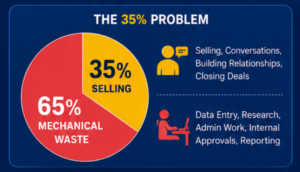
In the modern B2B landscape, a silent epidemic is draining revenue and burning out top talent: the “Mechanical Waste Vortex.” While businesses hire sales stars for their ability to build relationships and close deals, research reveals a staggering reality, the average sales rep spends only 28% to 35% of their week actually selling. The remaining two-thirds of their day is consumed by what we call “Mechanical Waste”, the binary, repetitive administrative tasks that should be the domain of machines, not humans.
Identifying the Administrative Tax
Before you can fix your pipeline, you must identify where your time is leaking. Mechanical Waste is not just “busywork”; it is a direct tax on your win rates. On average, a 40-hour workweek for a B2B rep evaporates into these specific buckets:
– CRM Drudgery (17%): Manual logging of calls, updating deal stages, and tagging records.
– The Research Grind (14%): Reps often spend 1 to 3 hours per account toggling between LinkedIn, news sites, and company websites to find buying signals.
– Administrative Friction (26%): This includes internal meetings, scheduling, drafting first-pass emails, and chasing internal approvals.
– The “Bad Data” Tax: Reps lose roughly 27.3% of their time working with inaccurate contact data, dialing wrong numbers and researching contacts who have long since left their companies.
What AI Should Be “Eating” Today
The transition to a Hybrid Sales Powerhouse begins by offloading “Structured Work”, tasks that are repetitive, data-driven, and inherently binary, to AI agents. Here are the specific tasks AI should be “eating” to fuel your growth:
1. Automated Account Intelligence: Instead of manual research, tools like Apollo.io and Salesmotion can aggregate data from thousands of sources into a single account brief in minutes, reclaiming up to 20 hours per week.
2. CRM Hygiene & Activity Capture: Platforms like Salesforce Einstein, Gong, and monday CRM automatically log calls, transcribe meetings, and update deal stages, reducing CRM admin time by up to 50%.
3. Predictive Lead Scoring: Stop wasting 40% of your time on dead-end leads. AI analytics can rank prospects based on historical patterns to identify the 10% that are genuinely ready to convert.
4. Autonomous Outreach & Follow-up: Agentic AI can independently manage multi-step follow-up sequences and handle basic objections, ensuring no lead goes cold while a rep is tied up in a meeting.
5. Proposal & RFP Automation: AI agents can draft custom proposals and respond to RFPs 90% faster than manual creation, significantly shortening the sales cycle.

The ROI of Reclaiming Your Day
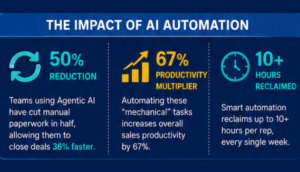
The math for sales leaders is clear: if you move your team from 28% selling time to 38%, you effectively add seven full-time sellers to a 20-person team without making a single new hire. Organizations that lean into this transformation see:
– 30% more wins and 36% faster sales cycles.
– A 67% increase in sales team productivity.
– Up to a 15% immediate revenue uplift.
The Human Edge: Mastering the “Art”
By letting AI handle the “Science” of sales, the data entry, the research, and the scheduling, you liberate your team to focus on the “Art”. This is the realm of unstructured work that AI cannot replicate: building genuine trust, artfully handling complex objections, and navigating the emotional nuances of a high-value deal.
In 2026, the status symbol of a premium brand is not how much AI they use, but how well they use AI to augment human connection.
Ready to find your team’s missing 65%? At Hashtaqs, we don’t just provide tools; we drive the Brand and Business Transformation required to turn AI efficiency into measurable ROI. We help you audit your “Mechanical Waste” and redesign your playbook for the autonomous age.
Stop the waste and start scaling. CONTACT HASHTAQS to transform your revenue engine today.
Contact us at
Email: [email protected]
Phone: +65 8868 1418
Sources:
1. The Sales Efficiency Frontier (The 35% Problem)
Salesforce (State of Sales Report, 6th Edition): Confirms that sales representatives spend only 30% of their time actually selling, with 70% lost to administrative and non-selling tasks,.
McKinsey & Company: Their research into freeing the sales force indicates that reps in various sectors, such as logistics, spend just 35% of their day on revenue-generating activities.
Stork.AI: Highlights that for every hour an employer “buys,” they receive only 21 minutes of actual selling, leading to the “Glorified Data Entry Clerk” epidemic,.
Salesmotion: Detailed analysis shows the breakdown of the remaining 72% of the week, which includes CRM data entry (17%), internal meetings (15%), and manual research (14%).
2. The AI Failure Epidemic & Organizational Gaps
Gartner: Predicts that 90% of AI projects will fail by 2026 and notes that 60% of these failures stem from poor data quality,.
RAND Corporation: Their analysis of over 2,400 initiatives found that over 80% of AI projects fail, a rate twice as high as regular IT projects,.
Folio3 AI: This source identifies that 77% of AI failures are organizational (strategy, governance, and change management) rather than technical,.
MIT Project NANDA: Their study revealed that 95% of generative AI pilots produced zero measurable P&L impact, often because they were launched without a defined business outcome,.
Wavestone Survey: Cited as the authority for the statistic that 91.9% of executives view cultural obstacles as the primary barrier to AI success.
3. The 10/20/70 Success Framework
Boston Consulting Group (BCG): The original architect of the 10/20/70 rule, which states that 10% of AI effort is algorithms, 20% is technology/data, and 70% is people and process transformation.
Artefact: Provides real-world proofs for the “70/30 rule”—that implementation is 30% technical and 70% cultural—and discusses the dangers of “Pilot Purgatory”,.
4. ROI & Performance Multipliers
Ormidium Tech (via HatHawk): Found that B2B teams using agentic AI closed 30% more deals and cut sales cycles by 36% in early 2026,.
Sprouts.ai: Documents that companies investing in sales automation see an immediate revenue increase of 3% to 15% and a 10% to 20% sales ROI improvement.
Agentically: Reports that AI agents can increase overall sales team productivity by 67% and improve deal closure rates by 43%.
McKinsey & Company: Their research suggests that one-fifth (20%) of current sales-team functions can be fully automated today.
5. Customer Journey & Modern Buying Habits
Gartner (2024 Survey): Reveals that 61% of B2B buyers now prefer a sales experience with no representative involved, highlighting the shift toward self-directed journeys,.
Erasmus University Thesis: Explores the “Personalization-Consistency Paradox” and the “Recommendation-Choice Paradox” specifically for premium brands navigating AI-driven customer journeys,.


