
In the current gold rush of technological possibilities, many B2B leaders are realising that value requires more than just installing new software. While the allure of “agentic AI” and “digital twins” is strong, the bridge between a successful proof-of-concept and scalable business value is rarely built with better code, it is built with process reinvention and cultural evolution.
The ROI Reality Check: The 10/20/70 Rule
The most critical principle for success in 2026 is what experts call the “70/30 rule”: implementation is 30% technical and 70% cultural.
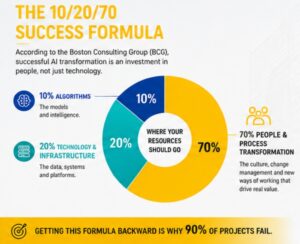
To put it even more precisely, successful organizations follow the 10/20/70 framework pioneered by the Boston Consulting Group:
– 10% of your resources should go to algorithms.
– 20% goes to technology and data infrastructure.
– 70% must be devoted to people and processes.
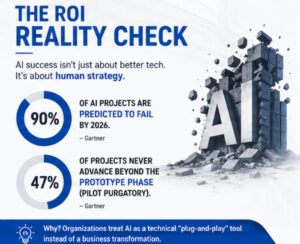
When organizations get this formula backward, they find themselves among the 47% of AI projects that never advance beyond the prototype phase, remaining trapped in what is known as “pilot purgatory”.
Why Do AI Projects Stall?
The problem rarely lies with the math; it lies with the mindset. 91.9% of executives recently cited cultural obstacles as the greatest barrier to AI success, compared to only 8.1% who blamed the technology.
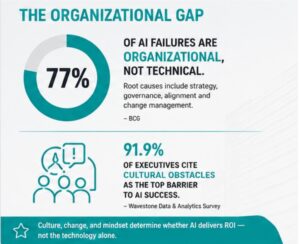
Projects fail when leaders start with the “what” (the tech) instead of the “why” (the business problem). Great leaders cultivate a culture of customer obsession, ensuring every AI initiative solves a specific problem with measurable outcomes, such as revenue growth or cost efficiency. This aligns people around a shared purpose, rather than just a shared tool.
Finding the “Low-Hanging” ROI
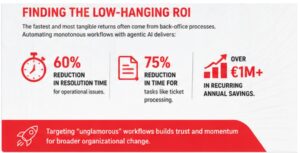
While high-profile, customer-facing AI gets the headlines, the fastest and most tangible returns often hide in your back-office operational processes. By automating monotonous workflows with agentic agents, organizations have seen:
– A 60% reduction in resolution time for operational issues.
-A 75% reduction in time for tasks like ticket processing.
– Over €1 million in recurring annual savings.
Targeting these “unglamorous” workflows builds the trust and momentum needed for broader organizational change.
Evolution Over Revolution
The tech world loves the idea of “disruption,” but for established brands, an evolutionary approach is more sustainable. Rather than a “rip-and-replace” overhaul that triggers organizational fear, smart leaders focus on augmenting existing processes. This integrates innovation into the company’s DNA without causing the chaos that often leads to total project abandonment.
The Hashtaqs Perspective: Leading, Not Just Managing
Ultimately, the race to AI maturity will be won not by the organization with the most powerful technology, but by the one that best aligns its tech with its human strategy.
Successfully navigating this transformation requires a shift from management (spreadsheets and oversight) to leadership (inspiring a shared vision and high-trust environment). At Hashtaqs, we specialize in this Brand and Business Transformation. We help you lead the transformation of your people and processes so that your machine precision is always guided by human judgment.
The technology is ready. Are your people?
Ready to build your strategic foundation? Explore how Hashtaqs transforms AI potential into P&L impact at Hashtaqs.com.
Contact us at [email protected]
Whatsapp: +65 8868 1418 (SG) | +6011 1616 3281 (MY)
Sources:
Author: The original article was written by Niels Thomsen, a Partner at Artefact Germany.
The 10/20/70 Rule: The core framework used in the blog, allocating 10% of resources to algorithms, 20% to technology, and 70% to people and processes, is attributed to the Boston Consulting Group (BCG).
Pilot Purgatory: The statistic regarding 47% of AI projects failing to move past the prototype phase comes from Gartner.
Cultural Obstacles: The insight that 91.9% of executives view cultural barriers as the primary challenge to AI success is cited from the Wavestone Data & Analytics Survey.


